Marriage biodata
Marriage Biodata Format: What to Include and How to Lay It Out
The sections an Indian marriage biodata is expected to carry, what to write in each, and how to lay it out — with a full sample, Hindi headings and templates.
On this page
- Biodata, resume and CV: not the same document
- What to include, section by section
- A sample marriage biodata
- Biodata headings in Hindi
- Layout and design: what reads well
- What to leave out, and what to keep private
- Writing partner preferences that help
- Special situations
- Before you send it
- Frequently asked questions
A marriage biodata is the document Indian families exchange at the start of a marriage proposal — passed between relatives, forwarded in WhatsApp groups, sent to a marriage bureau or attached to a matrimonial profile. It is often the very first impression one family has of another, and it is usually read in under a minute.
Unlike a resume, it is not about work history. It introduces a person and their family: who they are, where they come from, what they do and what they are looking for. Here is what to include, in the order families expect to read it, with a complete sample you can adapt.
The short answer
A marriage biodata should have a recent photo, personal details (name, date of birth, height, religion and community), education and career, family details (parents and their occupations, siblings, native place), horoscope details if your family follows them, a few lines of partner preferences, and contact details. Keep it to one page if you can, two at most, and share it as a PDF.
Biodata, resume and CV: not the same document
The words get mixed up, but they are different documents with different readers:
| Marriage biodata | Resume | CV | |
|---|---|---|---|
| Purpose | Introducing a person and family for a marriage proposal | Applying for a job | Academic, research and some senior roles |
| Read by | Families, relatives, matchmakers | Recruiters and screening software | Academic panels, employers |
| Focus | Personal, family and horoscope details | Work achievements and skills | The complete academic and professional record |
| Photo | Expected | Usually left off | Depends on the country |
| Length | One page, two at most | One to two pages | As long as it needs to be |
So a biodata is not a resume with a photo added. If you are job hunting as well, see how to write a resume that gets read — the two need quite different content.
What to include, section by section
Families have read hundreds of these, and they expect to find things in roughly this order. Following it makes your biodata easy to read, and easy to compare.
1. An opening line (optional)
Many biodatas begin with a short invocation at the top, in keeping with the family’s tradition — ॥ श्री गणेशाय नमः ॥ in many Hindu families, ੴ (Ik Onkar) in Sikh families, “Bismillah” in many Muslim families, or a cross for Christian families. It is entirely optional. A biodata without one is just as correct.
2. Photo
The photo is looked at before anything is read, so it is worth getting right:
- Recent — taken within the last year.
- Clear and well lit, facing the camera, from the chest up.
- A plain or softly blurred background.
- Light editing at most. Heavy filters get noticed, and the first meeting shows the truth anyway.
- Formal or traditional clothes, as your family prefers. If you want to share more pictures, send one or two separately rather than crowding the page.
3. Personal details
- Full name
- Date of birth — some families add the age as well
- Height — in feet and inches, with centimetres if the biodata may travel abroad
- Religion, and caste or community — if they matter to your family
- Mother tongue
- Marital status — never married, divorced or widowed
- Diet — vegetarian, eggetarian, non-vegetarian, Jain or vegan
- Blood group, if you like
4. Education and career
Give your highest qualification first, with the institution — “B.Tech, Computer Science, Delhi Technological University”. Then your current work: designation, employer, and the city you work in. Annual income is optional; many people give a range or write “shared on request”. If you are in a family business, describe it in a line: what it does and your role in it.
5. Family details
- Father’s name and occupation, with “Late” before the name if he has passed away
- Mother’s name and occupation — “homemaker” is a perfectly good occupation
- Siblings — elder or younger, what they do, and whether they are married
- Family type — nuclear or joint
- Native place, and where the family lives now
Some families also describe their values — traditional, moderate or liberal. Useful if it is honest; leave it out if you are not sure what it would signal.
6. Horoscope details, if your family follows them
If horoscopes will be matched, give the details an astrologer needs: time of birth (as exact as you can), place of birth, rashi, nakshatra, gotra, and whether you are manglik. Copy these from your kundli rather than from memory — a wrong birth time changes the chart. If your family does not follow horoscopes, leave the whole section out.
7. Partner preferences
Two to four lines on what you are looking for. It is the one part of a biodata written in your own voice, so it says a lot about you. There is more on writing it well below.
8. Contact details
A phone number — often a parent’s — and an email address. A city or locality is enough for the address at first; share the full address once there is interest on both sides.
A sample marriage biodata
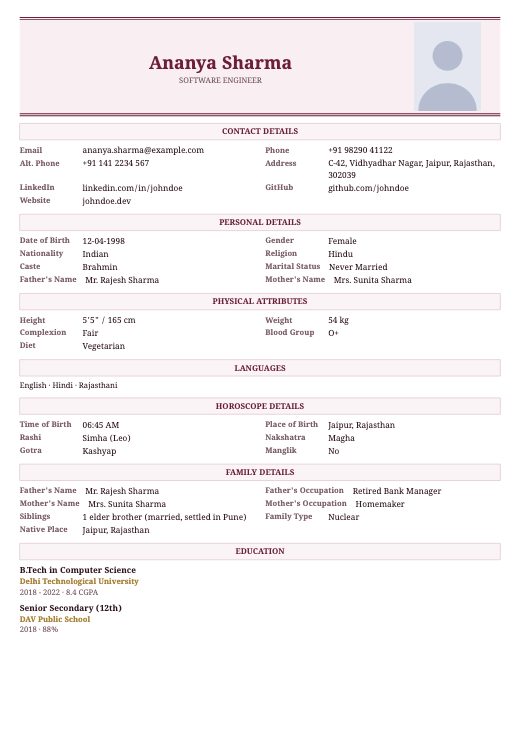
Here is a complete example with every section filled in. The details are made up; the structure is what to borrow.
॥ श्री गणेशाय नमः ॥
Ananya Sharma
Software Engineer · Jaipur
Personal details
- Date of birth
- 12 April 1998
- Height
- 5′5″ (165 cm)
- Religion
- Hindu
- Community
- Brahmin
- Mother tongue
- Hindi
- Marital status
- Never married
- Diet
- Vegetarian
- Blood group
- O+
Education and career
- Education
- B.Tech, Computer Science — Delhi Technological University (2022)
- Occupation
- Software Engineer at a product company
- Work location
- Jaipur
- Annual income
- Shared on request
Family details
- Father
- Mr. Rajesh Sharma — Retired Bank Manager
- Mother
- Mrs. Sunita Sharma — Homemaker
- Siblings
- One elder brother, married, settled in Pune
- Family type
- Nuclear
- Native place
- Jaipur, Rajasthan
Horoscope details
- Time of birth
- 6:45 AM
- Place of birth
- Jaipur, Rajasthan
- Rashi
- Simha (Leo)
- Nakshatra
- Magha
- Gotra
- Kashyap
- Manglik
- No
Partner preferences
Looking for a well-educated, kind and family-oriented partner who has his own goals and respects mine. Open to any profession; ideally settled in, or willing to move to, a metro city.
Contact
- Phone
- +91 98XXX XXXXX (father)
- ananya.sharma@example.com
- Address
- Vidhyadhar Nagar, Jaipur
Every biodata template on CraftCVPro starts with these sections already laid out, and you can rename, reorder, hide or add to them — a “Hobbies” section, say, or an extra row for your sub-caste.
Biodata headings in Hindi
Many families prefer a biodata in Hindi, or in English with Hindi headings. These are the terms most commonly used:
| English | Hindi |
|---|---|
| Biodata | बायोडाटा / जीवन परिचय |
| Personal details | व्यक्तिगत विवरण |
| Name | नाम |
| Date of birth | जन्म तिथि |
| Time of birth | जन्म समय |
| Place of birth | जन्म स्थान |
| Height | कद |
| Religion / Caste | धर्म / जाति |
| Mother tongue | मातृभाषा |
| Education | शैक्षणिक योग्यता |
| Occupation | व्यवसाय |
| Family details | पारिवारिक विवरण |
| Father’s name | पिता का नाम |
| Mother’s name | माता का नाम |
| Brothers / Sisters | भाई / बहन |
| Native place | मूल निवास |
| Gotra | गोत्र |
| Rashi / Nakshatra | राशि / नक्षत्र |
| Manglik | मांगलिक |
| Partner preferences | जीवनसाथी से अपेक्षाएँ |
| Contact details | संपर्क सूत्र |
| Address | पता |
Hindi is where many online biodata makers fall down. Devanagari needs proper font shaping, and without it the matras and conjuncts break apart or print as empty boxes. The templates on this site shape Hindi with a real Devanagari font, so a line like ॥ श्री गणेशाय नमः ॥ prints exactly as you typed it.
Layout and design: what reads well
- One page if at all possible. A biodata is read quickly, often on a phone. If it spills onto a second page, it usually has too much in it.
- The photo at the top — in a top corner, or centred under the name.
- Clear section headings, with details set out as a label and a value — Height, then 5′5″ — which is far quicker to scan than sentences.
- A readable font size. Grandparents will read it too, often on a phone.
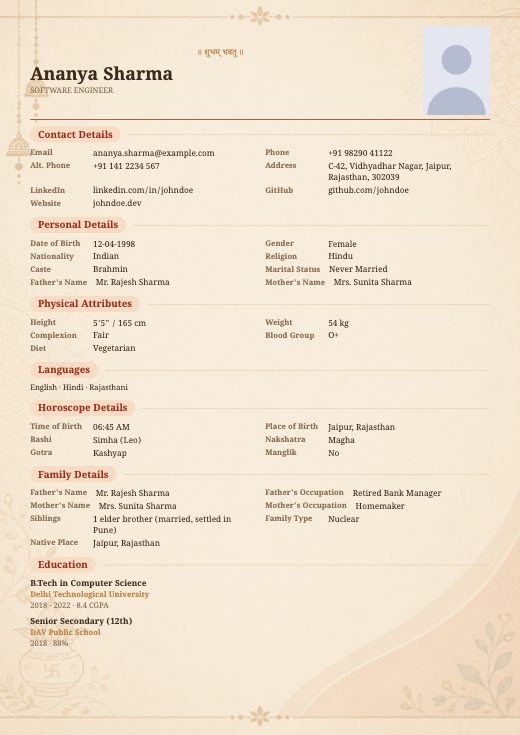
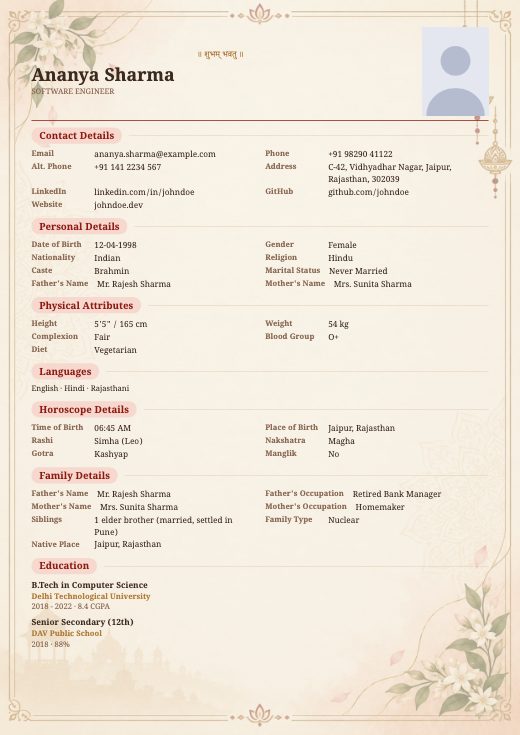
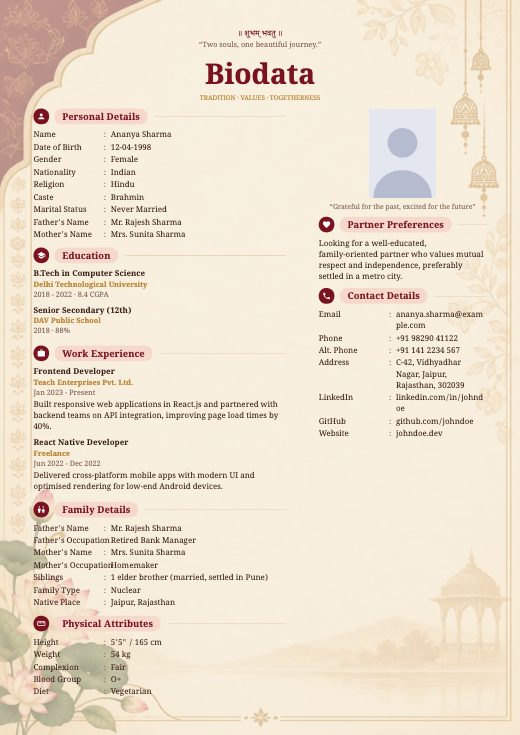
- Traditional design, used lightly. Borders, a kalash, lotus or floral artwork, maroon, gold and saffron all look lovely — as long as the text on top stays easy to read.
- Share it as a PDF. A PDF keeps its layout on every phone and prints cleanly. A photo of a printed page is blurry by comparison, and a Word file can rearrange itself on someone else’s phone.
What to leave out, and what to keep private
A biodata gets forwarded far beyond the people you send it to, so think about what you would be comfortable with a stranger reading.
- Identity numbers. Never include Aadhaar, PAN, passport or bank details.
- Your full home address, at first. City and locality are enough until there is interest on both sides.
- Exact salary figures, unless you are comfortable with them circulating. A range, or “shared on request”, works well.
- Long lists of hobbies and life stories. Two or three interests that say something real about you are plenty.
- Complexion and weight, if you would rather not. They are traditional fields, but more and more families leave them out — and phrases like “fair and slim” in partner preferences put off many of the people reading them.
Writing partner preferences that help
This short section is read closely. A list of physical requirements comes across as demanding, and something vague says nothing. The best ones describe values and practical needs:
Instead of
Looking for a fair, slim, tall, homely girl from a good family.
Write
Looking for a kind, educated partner who values family and has her own ambitions. Open to any profession; ideally based in, or willing to move to, Bengaluru.
Instead of
Should be well settled.
Write
Looking for someone settled in their career and ready for marriage, who enjoys travel and would like to live in Pune or Mumbai.
Do keep the practical requirements that genuinely matter — location, diet, whether you plan to live with your parents, whether you are open to moving abroad. They save both families time.
Special situations
A second marriage
State your marital status plainly — divorced or widowed — and, if you have children, how many and who they live with. There is no need to explain the circumstances in the biodata; that conversation comes later. A clear, matter-of-fact biodata tends to reach the right families.
Living abroad
Mention the country and city, your residency status in general terms (citizen, permanent resident, work visa), and whether you plan to return to India or expect your partner to move. Families will ask about these first.
A family business
Describe it in one line — what it does, how long it has been running, and your role — rather than writing only “business”.
Before you send it
- A recent, clear photo.
- Name, date of birth, height, religion or community, and marital status.
- Education, and your current work with the city you work in.
- Both parents’ names and occupations, siblings and native place.
- Horoscope details copied from the kundli — or left out entirely.
- Partner preferences in two to four honest lines.
- A contact number that is correct, and says whose it is.
- No Aadhaar, PAN or full home address.
- Fits on one page (two at most), saved as a PDF.
When you are ready, choose a biodata design, fill in the sections above, and download a PDF to share on WhatsApp — free, with no sign-up, and nothing uploaded anywhere.
Frequently asked questions
What should be included in a marriage biodata?
A recent photo; personal details such as name, date of birth, height, religion and marital status; education and career; family details including parents, their occupations, siblings and native place; horoscope details if your family follows them; a few lines of partner preferences; and contact details.
How long should a marriage biodata be?
One page is ideal, and two pages is the most it should need. Biodatas are read quickly, often on a phone, so a crowded second page usually means something can be cut.
Is it necessary to include horoscope details in a biodata?
No. Include time and place of birth, rashi, nakshatra, gotra and manglik status only if your family, or the families you expect to hear from, match horoscopes. If you do include them, copy them from the kundli rather than from memory.
Should I mention my salary in a marriage biodata?
It is optional. Many people give an annual income range, or write that it will be shared on request, rather than an exact figure that will circulate widely.
Can I make a marriage biodata in Hindi?
Yes. You can write the headings and details in Hindi, or mix Hindi headings with English details. Make sure the tool you use shapes Devanagari properly; the templates on CraftCVPro do, so Hindi prints correctly in the PDF.
What is the best format to share a biodata on WhatsApp?
A PDF. It keeps its layout on every phone, can be zoomed without blurring, and prints cleanly. A photo of a printed biodata is harder to read, and a Word file can look different on someone else’s phone.
Should caste be mentioned in a marriage biodata?
It is a personal and family decision. If matching within a community matters to your family, include it; if it does not, you can leave it out or write that caste is no bar.
Make your biodata in a few minutes
Eight biodata designs, several on traditional artwork, with Hindi that prints properly. Free, no sign-up, a real PDF you can send on WhatsApp.
Choose a biodata designWritten by the team that builds CraftCVPro’s resume engine and ATS check. We don’t quote statistics we can’t source, and we update these guides when hiring practice changes. Last reviewed .
Keep reading
All guides →
Resume writing
How to Write a Resume That Gets Read
What a recruiter looks at in the first six seconds, and how to put it there.
Read the guide· 11 min
ATS & screening
ATS-Friendly Resume Tips: How to Get Past the Screening Software
Why some resumes never reach a human, and the formatting choices that cause it.
Read the guide· 9 min
Resume writing
Which Skills Actually Belong on a Resume
How to choose the ones that match the job instead of listing everything you know.
Read the guide· 8 min